Staff Artificial Intelligence Guidelines
Hilliard City Schools is committed to preparing students to be ready for their tomorrow. As technologies develop, Hilliard City Schools sets forth clear guidelines for the responsible, ethical, and effective use of technologies to enhance the high-quality PK-12 education our students receive. By integrating AI tools, Hilliard City Schools aims to:
- Maintain a human-centered approach: Use AI as a way to foster more human time allowing educators to enhance Hilliard’s Portrait of a Learner competencies.
- Personalize learning: Tailor instruction to individual student needs while promoting creativity, critical thinking, and student engagement.
- Optimize operations: Streamline administrative tasks and enhance efficiency.
- Promote ethical AI Use: Ensure AI systems are transparent, unbiased, and privacy-focused.
Ultimately, we seek to prepare our students for the future by fostering innovative and responsible AI practices. This guide is aimed at assisting staff, administrators, and students.
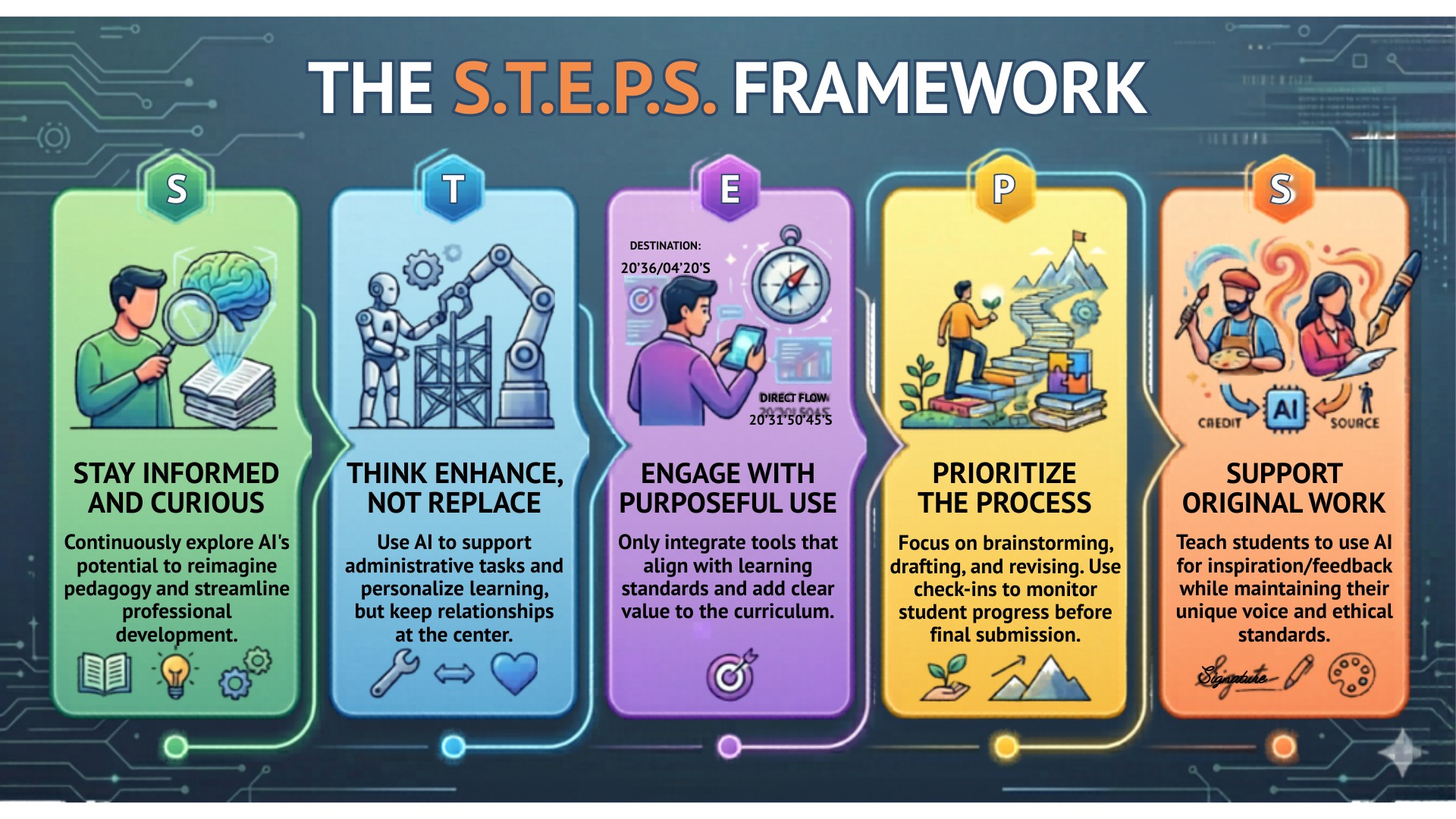
To build your knowledge of AI, keep these S.T.E.P.S in mind.
Defining AI Student Use in the Classroom
The district encourages teachers to use the following table to explicitly state when AI use is permitted, restricted, or prohibited for specific tasks depending on the expected learning outcomes and experiences. Refer to the image below.
Benefits
Guidance & Expectations
NO AI
The assessment is completed entirely without AI assistance in a controlled environment, ensuring that students rely solely on their existing knowledge, understanding, and skills.
Requirement: You must not use AI at any point during the assessment. You must demonstrate your core skills and knowledge.
AI PLANNING
AI may be used for pre-task activities such as brainstorming, outlining, and initial research. This level focuses on the effective use of AI for planning, synthesis, and ideation, but assessments should emphasize the ability to develop and refine these ideas independently.
Requirement: You may use AI for planning, idea development, and research. Your final submission should show how you have developed and refined these ideas.
AI COLLABORATION
AI may be used to help complete the task, including idea generation, drafting, feedback, and refinement. Students should critically evaluate and modify the AI-suggested outputs, demonstrating their understanding.
Requirement: You may use AI to assist with specific tasks such as drafting text, refining and evaluating your work. You must critically evaluate and modify any AI-generated content you use.
FULL AI
AI may be used to complete any elements of the task, with students directing AI to achieve the assessment goals. Assessments at this level may also require engagement with AI to achieve goals and solve problems.
Requirement: You may use AI extensively throughout your work either as you wish, or as specifically directed in your assessment. Focus on directing AI to achieve your goals while demonstrating your critical thinking.
AI EXPLORATION
AI is used creatively to enhance problem-solving, generate novel insights, or develop innovative solutions to solve problems. Students and educators co-design assessments to explore unique AI applications within the field of study.
Requirement: You should use AI creatively to solve the task, potentially co-designing new approaches with your instructor.
Copyright: Perkins, Furze, Roe & MacVaugh (2024). The Al Assessment Scale